Saturday, 13 October 2018

Diploma Chapter 10 - Contemporary Stitched Samples to Translate Areas of Decorated Papers

The first two samples are based on MM134 from my shisha textile study in Chapter 6.


Sample 1 - Image MM185


Image MM134 was inkjet printed onto Seawhites 140gms extra wet strength paper.  The centres of the circles were removed using a scalpel. Inside top papers from Nescafé Azera, Philadelphia cheese and crab pate - each with different surface shininess - were polished using the back of a teaspoon and then embossed using the original stitched punch pocket as a relief source.  Again the centres were cut out.  Using free machine embroidery, a 90 ballpoint needle, metallic thread in the top and grey cotton in the bobbin, herringbone stitch from the design was mirrored to attach the embossed metallic circles and add additional detail.  Though some of the embossing was lost through handling, enough was retained to give the three metallic circles the characteristic relief of the original design.

Sample 2 - Image MM186


Using waxed calico (prepared as in the first section of Chapter 2) and handstitching, this sample contains the main design features of MM134.  The centres of the cirles were removed before stitching and the holes used by the herringbone stitch were made using an awl before stitching. Image MM187 shows the surface texture created.


Sample 3 - Image MM188


This sample used the tissue from Image MM123 which was attached to even weave fabric using paraffin wax.  It was then hand stitched with metallic thread - French knots of various sizes, running stitch and back stitch to emphasize the main features of the design and add surface texture. Image 189 shows the surface texture created, both with the stitching and the wax.


Sample 4 - Image MM190


The blue teabag paper decorated with Markal Paintstik from Image MM91 was attached to evenweave using dilute PVA.  This stabilised the teabag paper and gave a background for machine stitch.  The outer circles were free machine embroidered with metallic gold on the top and navy machine embroidery thread in the bobbin in a circular motion.  The tension was adjusted to pull the bobbin thread to the surface. The inner circles used light blue metallic in the bobbin.  Due to the vagaries of metallic thread this was more difficult to control and therefore less prevalent on the surface of the work.  The additional details were free machined, sometimes using ziz-zag to represent dots.  This sample fell a bit flat.


Sample 5- Image MM192


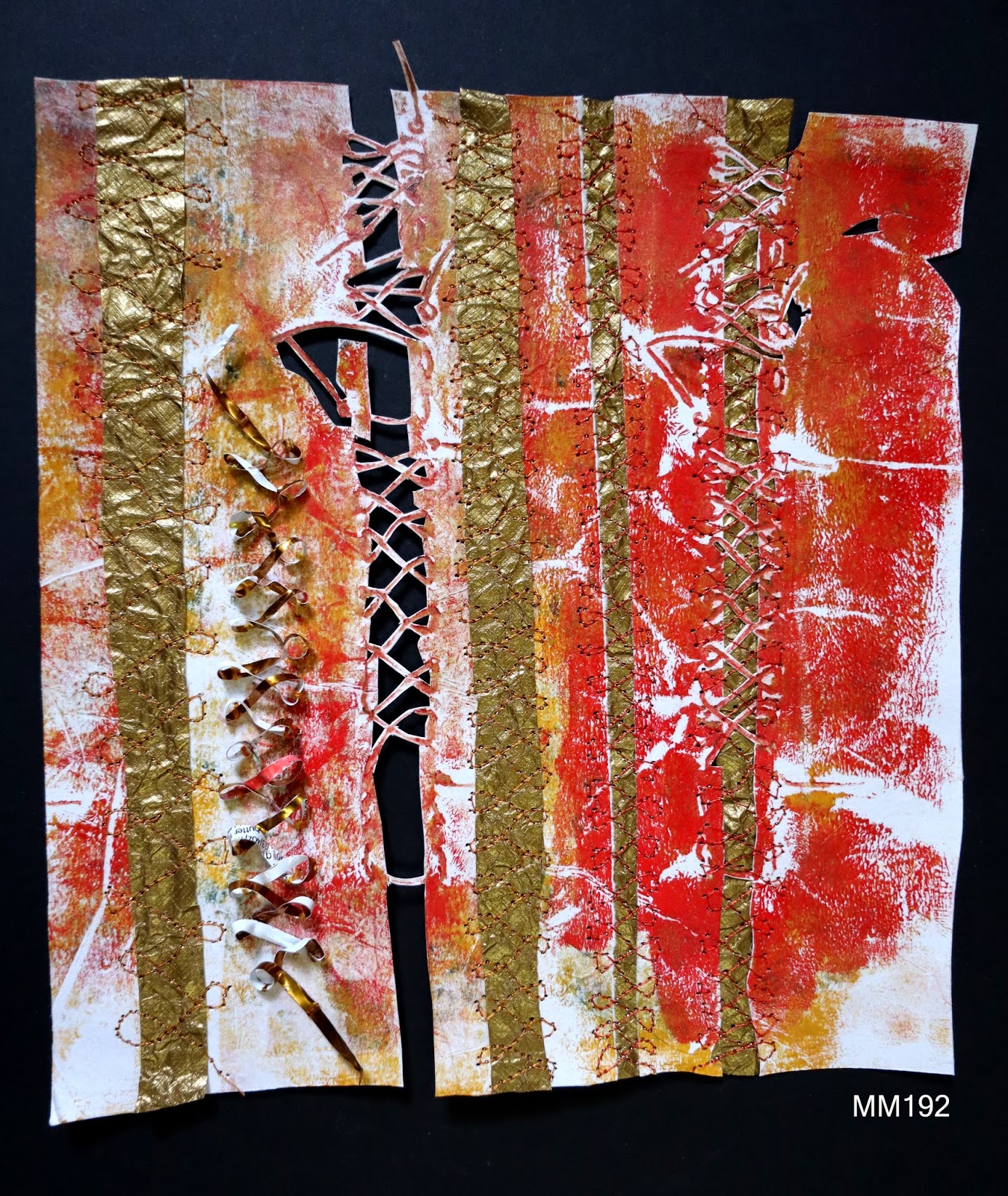
The tissue image from MM138 was attached to Seawhites 140gms extra wet strength paper using dilute PVA.  The paper created was cut in half and repositioned.  Using a scalpel, parts of the design were removed. I put a few drops of baby oil in my hands and kneaded gold wrapping paper from a box of Marks and Spencer chocolates until the paper became soft and pleasantly creased - momigami - Cas Holmes, The Found Object in Textile Art pages 37-39.  Strips of this gold paper were attached infront and behind the original design with free machine embroidery, mirroring the original herringbone stitching - Image MM191.


I felt this needed more surface texture, so added more topping.  I cut a continuous strip from a tomato pureé tube and couched this to the surface, again mirroring the feeling of the original herringbone stitching - Images MM192/3.


Further Ideas for Applying Fragments of Metal with an Automated Machine Stitch

For both these samples I used a background from my shisha textile study in Chapter 6 - Image MM139 - acrylic on lining paper using gelli plate.


Sample 6 - MM194


Pieces of aluminium shim and silver tissue paper (for the oval) were cut and initially held in place with Pritt.  My Bernina 1015 is rather lacking in decorative stitch patterns, so for this sample many lines of straight stitch were made to hold the metallics in place.  These mirrored the brayer lines created when the sample was printed. The top thread was Madeira variegated metallic machine embroidery thread and the bobbin switched between red mercerised cotton and navy machine embroidery thread.  Some lines of machining had been done before the tissue was added and these picked up the texture of the stitching beneath. 

Sample 7 - MM195


Some of the design was initially cut away using a scalpel (fine detail right and oval on left).  Silver tissue was placed under the design to show through where cut.  Aluminium shim was added on top - detail round oval on left - and held in place with Pritt.  The design was stitched horizontally and vertically with Stitch Pattern 7 - a wavy line.  The top thread was as in Sample 6 with only red in the bobbin.

Sample 5 is the most promising for me as it:

  • is worked on paper
  • has paper cutting, useful for creating shadows
  • has layers
  • has interesting surface texture.

Wednesday, 10 October 2018

Chapter 9 - Alchemy! ...continued

How to Modify Real Metal Surfaces

Polish

MM172/3 - Nescafé Azera packaging front and back


MM174/5 This was rubbed with the back of a teaspoon which removed the embossing and smoothed the surface.


Heat

See Chapter 7.

Emboss

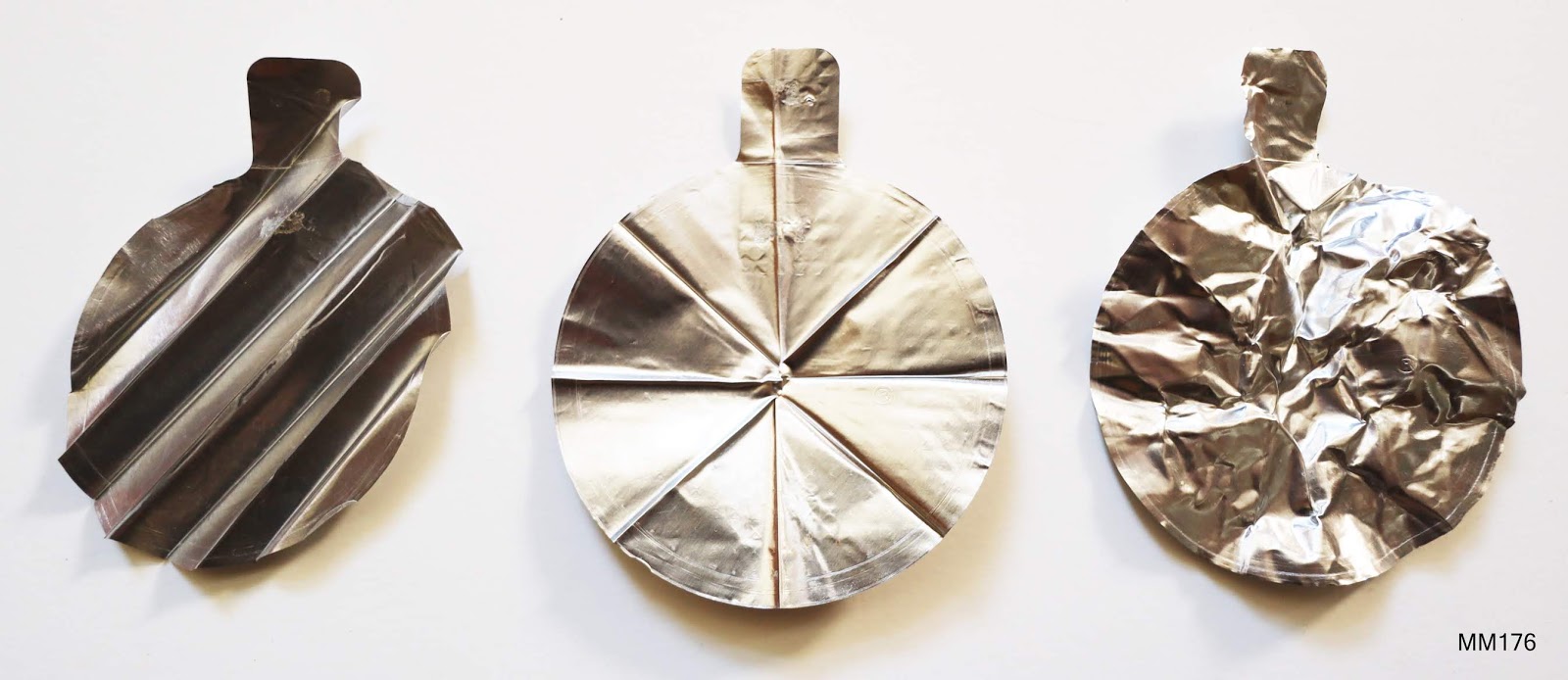
MM176  All surfaces were polished and then, from left to right - pleated, folded, scrunched by hand then partially flatten.


MM177 relief surface of wooden block 'copied' using embossing tool and rubbing with finger.


MM178 reverse of MM177.


MM179 various other relief surfaces created using rubbing surfaces and sequin waste.  Some were also highlighted with acrylic.


MM180 reverse of MM179.


MM181 rubbed with finger over sequin waste


MM182 various metallics fed through a crimping machine.


MM183 folded, punctured with an awl and areas highlighted with acrylic.  The effect from punching with a sewing machine needle can be seen in sample MM156.


MM184 metal placed on soft surface, 'drawn' into with embossing tool and highlighted with acrylic.


Patinate
Ongoing.

Monday, 27 August 2018

Chapter 9 - Alchemy!

*six month interlude*

Colour changes using a metallic thread combined with a coloured thread in machine stitched areas

Image MM157 used WARM rust thread with a selection of metallic threads, all of which were wound on bobbins. The whole sample was worked from the back, framed, and stitched using a darning spring rather than a darning foot.  The top tension was adjusted to vary the amount of colour present. 

The metallic threads used were, from top left to right: 100% nylon gold; Ackerman Isamet silver 0511; Asiro3 metallic variegated; Madeira metallic copper; green metallic; blue metallic; red metallic; skin coloured metallic; Impex gold; Madeira Gold3; Mez reflecta0314; DMC fil argent. Calico ground.


Image158 used COOL royal blue thread with the same metallics as in the above sample and was worked in the same way.  


Image MM159 is the top left square from Image MM158- my favourite!


Image MM160 uses a range of different blue threads - Isacord 3323; pale blue polyester; royal blue polyester; Madiera 2016 variegated; Coats 1210 variegated; Dewhurst cotton D8 royal blue - with Ackerman Isamet 0511 silver metallic thread.  The stitches are worked in different directions creating variations in the reflection of light as well as colour variations depending on the threads chosen.  Calico ground.


Image 161 is the back of Image MM160.  It is easier to see the colours used.


Use of Paints, Inks and Bronze Powders

Image 162 - black linen ground, rubbed with platinum markal paintstik over corrugated card and then overprinted with silver acrylic paint using polystyrene block


Image 163 - black cotton ground, sponged over stencil from Module 1, using L Cornelissen and Co pearl lustre, lilac pearl powder mixed with acrylic wax.


Image MM164 - lustre powder as above, sponged and dragged repeatedly over cardboard cut edge.


Use of Light Gold Markal Paintstik

Image MM165 - gold paintstik repeatedly rubbed over relief cardboard surface. Black linen ground.


Image MM166 - gold paintstik repeatedly rubbed over string stitched on plastic pocket. Black linen ground.


Image MM167 - paintstik on edge of cardboard cutout and dragged onto fabric using stencil brush. Black cotton ground.


Use of PVA

Image 168 - glue line drawn on black linen ground and silver foil applied when dry. This remained sticky so not ideal.


Use of Transfer Adhesive

MM169 - gull shapes cut from bond-a -web and slightly used silver foil (shown behind) ironed on.  Black linen ground.


Image 170 - negative shape from Image 169 applied in the same way.


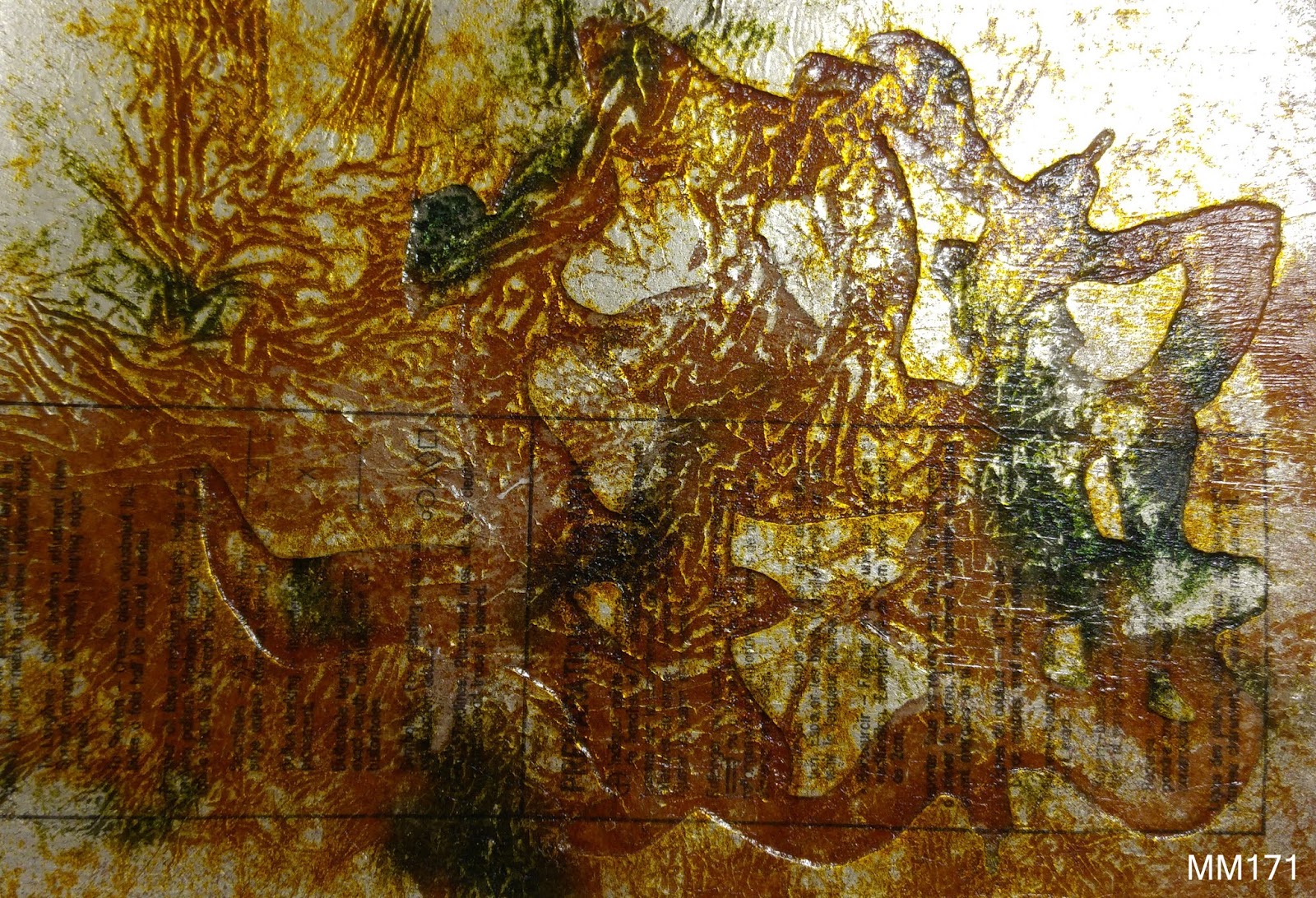
Image 171 - sample from Lynda Monk workshop using same gull design used previously cut out from coloured pelmet vilene and then foiled in the same way.  A dressmaking pattern has been applied on top of the foil using Golden matt medium to knock back the shine of the foil.


Wednesday, 6 December 2017

Chapter 8 - Use of Purls or Bullion

MM157/159 show examples of purls made using various materials that have been wrapped round different cores:
  • external telephone wire to house (thanks to Christmas storm of 2013) that was stripped down to reveal the seven wires inside.  Using one stand of the wire gave little memory when wrapped.  I tried wrapping it around the flat end of a 10" upholstery regulator and banging it with a hammer to try to 'help' it keep its shape but in the end I wrapped it round a pencil under pressure which gave me what you see. Three of the wires were plaited and then wrapped around a pencil.  The plaiting gave the wire more stability and inclination to keep its shape. Two samples were made of the wire twisted together - one with more twist - and these were again wrapped around a pencil under pressure.  More twists gave the wire more stability and inclination to retain the wrapping shape.
  • crochet yarn was wrapped round a cocktail stick, coated with dilute PVA , left to dry and removed.
  • paper-coated cake decorating wire was wrapped around a pencil.  This would give the option to colour the 'purl' as required.
  • smoothed Ferrero Rocher and silver sweet papers
  • kinked wire wrapped around pencil
  • plaited wire wrapped around pencil
  • other materials used were wires of various diameters and brown paper covered garden twine.


MM158 shows various tubular shapes made from looping around a mould.  The willow twig sampler was made at a wonderful weekend with Mary Crabb at West Dean and the additional shapes on returning home.  I include them here as they would give me the option of using a larger 'purl', made-to-measure tubular shape, diameter decided by the mould.   Paper yarn, wire and gold thread have been used to make the shapes. The paper yarn would again give the option to colour the shape.

Tuesday, 5 December 2017

Chapter 7 - Contemporary Shisha Ideas

Starting to collect items to be used for contemporary shisha, my first sample (MM146) was made using metal caps from the corks of champagne, prosecco, cava, etc bottles.  Though the metal caps have four ridges which would obviously assist with the anchoring stitches, I was more concerned in this sample in using different decorative stitches once the cap was in place.

The background gives continuity from the Opus Anglicanum samples, i.e. calico brushed roughly with dilute emulsion, gelli printed and waxed with paraffin wax to give the backing stability.  Once the caps were positioned/decoratively stitched, I couched down part of the muselets/wirehoods (the metal cages from around the corks) and blanket stitched over sections of their circular sections.  Finally holes were made in the waxed calico with an awl.

The decorative stitches/techniques used were:
  • needleweaving
  • spider's web, open worked and  ribbed spider's web
  • needlelace buttonhole net
  • screwcup washer covered closely with blanket stitch held in place over metal cap
  • couronne ring made on ring stick covered with buttonhole stitch
  • herringbone stitch.


MM147 shows the back.  In the bottom left you can see where I was overcautious in the number of anchoring stitches need.  I became more relaxed about this as the sample continued.


The second silver sample uses flat silver spangles, some of which have been cut into different shapes; aluminium shim; and traditional shisha mirrors. These have been held by:
  • couronne rings covered with blanket and belle point de venise cinq point stitches
  • square nut covered in symmetrical blanket stitch
  • many-sided nut covered in symmetrical blanket stitch
  • washers covered in blanket and belle point de venise cinq point stitch 
  • plastic ring covered in blanket stitch
  • needlelace buttonhole net
  • screwcup washer covered closely with blanket stitch held in place with herringbone stitch.


In sample MM149 I returned to my gull theme and cut gulls from a tomato purée tube.  I tried heating the tube over a candle unsuccessfully as it just covered in soot from the flame.  I then tried over the gas on the hob and it had no effect - just producing a strange smell.  Too late I read in Stitch, Fibre, Metal and Mixed Media by Alysn Midgelow-Marsden that it is a good idea to know what you are dealing with when it comes to metal and that most metals used for food storage have a plastic covering that when heated will give off fumes that are potentially toxic.  So I should have been wearing a face mask and working in a well-ventilated space.  Heath and Safety note to self!  A second note she gives is that the melting point of pewter, aluminium and tin is much lower than that of copper or brass and when they are placed in a strong heat they will melt.  This probably accounts for the fact that when I heated a piece of aluminium shim it just made the surface texture cloudy.  Image 145 shows the before and after heating of the shim.  She notes it is also advisable to clean metal with detergent before working with it to remove grease from the production process or previous use, which would interfere with the colouring and sealing of the metal.  Altogether I didn't have much luck heating metals.


After cutting out gull shapes from the tomato purée tube I marked the soft metal using a fine embossing tool.  They were attached to the background using couronne rings covered in blanket and belle point de venise cinq point stitches made from Impex 28 gauge pure copper wire.


MM150 - zooming in on gull held in position by couronne ring covered in belle point de venise cinq point stitch.


MM151 - zooming in on gull held by couronne ring covered in blanket stitch.


For my next sample I used the stitched relief block MM84. Rubbings were taken on teabag paper fragments using a gold Markal Paintstik (MM152).  


Using Golden Matt Medium, these fragments were laminated onto a calico background that has been lightly painted with emulsion and then brayered with acrylic paints.  This gave a faux chine collé effect (MM153).


Onto this background I placed traditional shisha mirrors which I held in place by free machine embroidery using Madeira variegated machine embroidery thread (MM154).


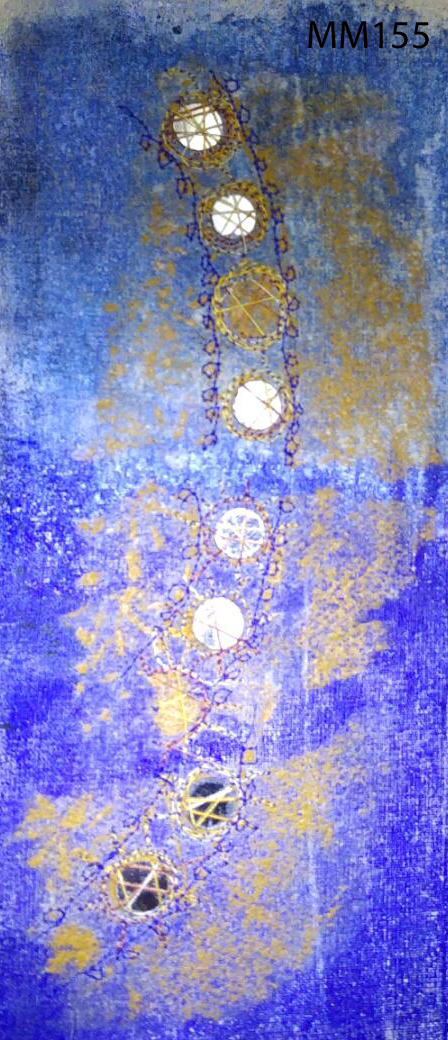
Additional stitching was added, again with free machine embroidery using Isacord machine embroidery thread (MM155).


The final sample, MM156, was worked on a print out of MM136.  The printer in its wisdom randomly coloured the printout but I went with the flow.  I ripped and recombined the printout using paraffin wax. Onto this I free-machine stitched cut pieces of metal foil from a prosecco muselet.  Additional free-machine stitching was then added.